 Upon a rainy day in Hanoi, Vietnam, but a couple of months ago I ventured off to The Vietnamese Women's Museum on recommendation by a few fellow travellers who were most impressed by the exhibitions. Being a culture junkie and ethnic textile enthusiast, I found myself positively in textbook heaven upon reaching the fourth floor, dedicated entirely to 'Womens Fashion's' of Vietnam's indigenous populations.
Having recently ventured into the depths of Laos and, previously, northern Thailand,I have a well established appreciation for the creative zeal of South East Asia's tribal minorities. In 2007 I trekked into the mountains of northern Thailand, spending a few days emersed in the fascinating culture of the Akha and Lisu groups whilst staying with them in their respective hill tribe villages. I was blown away by the abundance of dazzling embellishments, colour saturated appliqué and awesome oversized jewellery. Basically, it got me hooked.
As with many long standing indigenous cultures, handcrafted textiles, jewellery, headdresses and other such adornments are highly prized not just by the groups themselves, whose women perfect and pass on such traditional artistry from early childhood well into their adult lives, but by designer's and collectors around the world. But for the majority, who are relatively unexposed to such cultures, dedicated museum exhibitions such as this one are tremendously important. Set in place to both reach out and excite audiences, their role as an educative tool also draws attention to the fact that these diverse cultures, indigenous populations whose traditions stem back far beyond our own, are under threat from the pitfalls of the modern world.
As a designer myself I never fail to be captivated, inspired and impressed by the diversity and beauty interwoven within the wealth of techniques, patterns, motifs and styles of these tribal communities. I can't stress how important it is for us to help conserve the traditions of cultures like this all over the world, especially to the creative communities amongst us for whom these cultures can provide endless inspiration. Thus so I have put together this (super long!) post, with a few notes from the exhibition, in the hope that all of you may too be dazzled and intrigued by the beautiful handcrafted creations of these enterprising communities.
 Fashion & Motif Art
Like many indigenous cultures around the world, a women's skills end
experience are judged by the amount and quality of the textiles shes makes. Unfortunately nowadays this practice is becoming less and less important as more efficient, hard-wearing chemical dyes and
sewing machines have overtaken the traditional craft of loom weaving along with
the modernisation of traditional costumes to the point where they are often now
only worn for ceremonial occasions.
Within the 54 ethnic groups of
Vietnam cotton is the most popular
fabric and while natural silk is usually reserved
for festive costumes and appliqué, Hmong women mostly use fabric
woven from hemp, which is then dyed with indigo.
Pathen, Flower Lolo
and Flower Hmong traditionally have very colourful clothing and complex sewing
techniques. The Yao and Phula peoples favour
embroidery; Lolo and Pupeo, appliqué; Hmong and Yao Tien, batik; Thai and Khmer,
ikat, and the Muong, Tay and populations of the High Plateau prefer woven
patterns. Patterns and motifs generally vary with geographical location, traditional
tribal identities and local landscapes.
 Batik
Batik
Used by the Hmong and
Yao Tien.
Designs and patterns
are drawn onto fabric using melted wax. When the wax is dry the fabric is dyed
several times in indigo baths then immersed in boiling water to melt the wax.
The protected patterns appear as a light colour on an indigo background. This ankle length pleated skirt shown below is a typical example of traditional Hmong batik application.
Used by the Black
Thai, the Khmer and the Bahnar to create patterns with beautiful soft outlines.
Ikat is a dye
technique like batik, but instead of protecting the fabric before the dyeing
process, the threads are protected instead. Some threads are tied
up with plant or nylon fibres to protect them from the dyeing process which is
usually repeated several times to obtain a multicoloured thread that is used
for the weft during weaving. In some regions chain ikat is also used.

Appliqué
Used by indigenous populations
in the Nothern Mountains of Vietnam.
Small pieces of
coloured fabric are sewn onto a background to create patterns. Various coloured
fabrics are cut into geometrical forms and sewn on to the fabric while the
threads are hidden behind appliqué. Each group specialises in its own traditional
patterns such as the Hmong, who use a very
elaborate technique called reverse appliqué where the top layer of fabric is cut into
patterns to reveal the colour of the backing fabric.
 HEY! What are you doing?! Don't stop here, there's more to read (and, of course, more images) regarding hill tribe jewellery, adornments and headdresses! Click the link below to keep reading! DO IT NOW!


 Upon a rainy day in Hanoi, Vietnam, but a couple of months ago I ventured off to The Vietnamese Women's Museum on recommendation by a few fellow travellers who were most impressed by the exhibitions. Being a culture junkie and ethnic textile enthusiast, I found myself positively in textbook heaven upon reaching the fourth floor, dedicated entirely to 'Womens Fashion's' of Vietnam's indigenous populations.
 Fashion & Motif Art


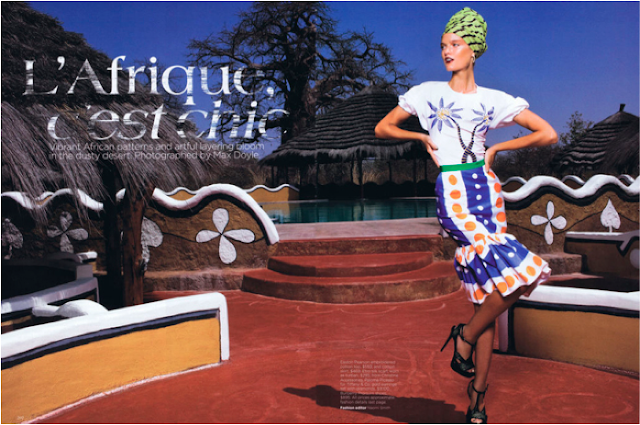 Whilst combing the shelves of an English language bookstore in Vientiane, Laos, a few weeks ago, my eyes were immediately drawn to the colourific, tribal-centric December issue of Australian Vogue. On its cover, the beautiful Isabel Lucas festooned with brightly beaded tribal inspired jewellery, her head overtyped with a somewhat unusually ethnic-patterned 'VOGUE'. Evidently, I snapped it up and being pleasantly surprised by the plethora of sunshine ready apparel and summery shades (reminding me that yes, back home you are all suffering through -2°C while, thankfully, the rest of the world is not), I have promised myself that from now on I shall endeavor to purchase an Australian Vogue through the bleak and dreary English winters.


 Shops like this are the reason I keep adding to my photographic collection of super bright, ethnic patterned fabrics, clothing and accessories - they make it so easy! I wondered into The Crafts Centre, again on Pokhara's Lakeside area, having been dazzled by the array of coloured weaves and embroidered homeware strategically placed out on the roadside.


